Scouting Report: Xavier Bourgault

Photo Credit: Cataractes de Shawinigan / Olivier Croteau

Xavier Bourgault is a 2021 NHL Draft eligible forward prospect, who hails from L’Islet, Quebec. L’Islet sits right on the St. Lawrence River and the Trans-Canada highway connects the town with Quebec City, Trois-Pistoles and Rimouski.

Bourgault is one of the older players in the 2021 NHL Draft class. His birthdate (October 22, 2002) is roughly a month shy of the NHL Draft class cut-off.

In his youth hockey days, Bourgault played bantam hockey with the Pointé-Levy Corsaires and midget hockey with the Lévis Chevaliers. During his bantam and midget days, he played with three of his current Shawinigan Cataractes teammates including William Veillette, Antoine Coulombe and Nicolas Daigle (only with Lévis).

Bourgault was drafted by Shawinigan in the 2018 QMJHL Draft in the second round at 33rd overall. Last season was Bourgault’s second season in the QMJHL and he led the 2021 NHL Draft eligible class in points with 71. In addition, he tied his fellow teammate and line-mate, Mavrik Bourque (Dallas Stars prospect) for points. This season, Bourgault has recorded 14 goals and nine assists in 19 games played (stats as of March 1, 2021).

Player Profile

D.O.B – October 22, 2002
Nationality – Canada
Draft Eligibility – 2021
Height –6’0
Weight –172 lbs
Position – Center/Right Wing
Handedness – Right

Bourgault’s Style Of Play

Position

While Bourgault has played center throughout youth hockey, he has spent a lot of time at right wing with the Cataractes. He remains a fixture on the top line with Bourque and fellow 2021 NHL Draft eligible prospect Olivier Nadeau.

Skating

When it comes to Bourgault’s skating, he is a straight line skater with wide skate placement. His wide skate placement hurts his mobility, but when in full stride, you don’t notice his wide skate placement. It is only when he slows down in the offensive or defensive zone. When he widens his skate placement, his mobility isn’t the only thing that fades away. His ability to reach forward for a poke-check also suffers.

In addition, I have noticed that there are times where Bourgault has challenges with his skate extension recovery. There are moments when Bourgault is looking to bring his skate back underneath his torso, but the extension was too long to begin with, so he fails to bring the skate completely back and falls. It’s similar issues to what Ottawa Senators prospect Roby Järventie deals with.

Not only does Bourgault have some challenges to overcome with his extension and recovery, his edges need more development as well. Sometimes when Bourgault is deploying his outside edges, he will use his left skate as an anchor without any knee flexion, but at the same time, he uses knee flexion on his right skate. Without both knees properly bent, it becomes tough to turn and utilize the outside edge properly.

He will also struggle with quick pivots when dealing with pressure at the boards. When facing a back-check in the offensive zone, he seems to struggle to find his way out of danger. Sometimes he will dodge traffic by squeezing through, but that won’t work most of the time especially at the NHL level. The goal should be to iron out his pivoting, so he can fool attackers and open up ice for himself.

Shooting

Aside from Bourgault’s skating, I want to touch on his shot next. Bourgault has solid range on his shot and is a threat in high and medium danger. The Quebecer loves draining one-timers and does a great job at elevating his shot. He can go top shelf from the low slot/door-step and all the way out at the perimeter. Bourgault can pick his corners with ease and tends to favor shooting at the blocker side, but will attack the glove side as well. His snap shot is very smooth and has a solid release.

Puck-Handling, Reach and Transition

One of Bourgault’s weaknesses is his reachability. There are times where he positions the puck way too far in front of him and he can’t hold onto the puck. Puck security is paramount to success. Bourgault needs to work on maintaining possession of the puck with tighter puck-handling.

But, I’ve also noticed some issues with his reach in the defensive zone. When the attacker is too far out in front of him, he will sometimes try to use his reach to poke-check, but given his limited reach, he needs to be much closer to the attacker to thwart the rush. Ultimately, Bourgault needs to develop better upper body strength to allow him to position his stick further out.

When in transition, Bourgault loves to either play the puck off the boards to navigate around the defender or dump and chase. Bourgault will shift the puck from forehand to backhand and throw a backhand pass to the boards to swerve around the attacker. Ultimately, his transitional play reminds me of Carolina Hurricanes prospect Seth Jarvis.

In terms of puck-handling at open ice, Bourgault reads movements from his opposition really well and adjusts his stick-handling on the fly. He will read their movements and play the puck away from the attacker.

Passing

When I watch Bourgault pass, I immediately think of Mavrik Bourque and how much I truly enjoyed watching him find tight lanes to pass through when I was evaluating him last year. If you thought that the Shawinigan front office wants to have a full lineup of Mavrik Bourque(s), well you are on the money. Bourgault passes like Bourque. Full stop.

Bourgault’s play-making ability is top-notch and he constantly finds lanes to deliver crisp passes through. But, his passing doesn’t just shine in the offensive zone, he also has shown great passing ability in the neutral zone. He identifies tight lanes to get the puck through to an open teammate (who is at the edge of blue-line). Plus, if traffic is bearing down on him, but he sees that Bourque has an open path to the offensive zone, he can and will utilize diagonal cross ice backhand passes to initiate zone entries. Bourgault constantly is reading his opposition and tailors his passing to their movements.

Finding Open Ice

Bourgault does a tremendous job at finding open ice. But, he doesn’t just apply that ability to his offensive zone play. He will use it in all three zones. Bourgault will pin point open ice in the neutral zone or in the defensive zone to help initiate a breakout. The strategy for Bourgault is always on the hunt for open ice to help with his team’s transitional play.

But, we can’t forget to mention how crucial his ability to find open ice is in the offensive zone. He uses his vision to understand player movements and find gaps to exploit. For example, check out the clip below, in which he skates unnoticed behind three attackers and gives his teammate an option in the low slot.

Defensive Play, Aggression, Forechecking

While Bourgault is outstanding when he is in control of the puck, there are some challenges when he does not possess the puck. As I mentioned above, his reachability hurts him when poke-checking. His wide skating stance hurts his mobility and slows him down when he is on the forecheck/back-check.

But, he is also not overly aggressive. When his teammates are on the forecheck/back-check, he plays more of a complimentary role. He supervises and stays at open ice. But, his positioning can be shaky at times. In the defensive zone, he’ll put himself in park at the perimeter and will sometimes adjust which side of the ice he is on if Nadeau has shifted to the other side.

In addition, Bourgault needs to be stronger at identifying potential threats in the defensive zone. Sometimes, he gives away too much space and gets lost puck tracking instead of identifying where the opposition is.

Comparison

Brendan Gallagher, Right Wing, Montréal Canadiens

Given Brendan Gallagher’s shooting ability and his ability to find open ice at a drop of a hat in all three zones, it seems like the perfect comparable for Bourgault. Also, both forwards are outstanding in transition. The only area where Gallagher is slightly different then Bourgault is the aggressive playing style. But, hopefully when Bourgault develops his skating more and more, he will be far more aggressive and speedy to the puck.

In addition to Gallagher, Cam Atkinson of the Columbus Blue Jackets is another solid comparable for Bourgault.

Projection

Top Six Winger (NHL).


stats from InStat and EliteProspects

Prospect report written by Josh Tessler. If you would like to follow Josh on Twitter, his handle is @JoshTessler_.

Looking for other scouting reports? Check out the Prospects tab for our other scouting reports.

Need a scouting report on a particular prospect, contact us today!

Scouting Report: Dario Allenspach

Photo Credit: Philipp Hegglin/ EV Zug

Almost every summer for the last ten years the NHL draft has provided us with a very specific type of player. The overlooked European over-ager. A player who was certainly good enough to be taken in their original draft year, but each team passed on at least seven times due to either perceived flaws or a lack of exposure.

Viktor Arvidsson is the poster boy for this. A junior international. Good numbers at age 16 and 17, a solid skill-set to boot. But three years in a row? No NHL team took a gamble on him due to his diminutive size. Those reasons were similar ones to Artemi Panarin going undrafted four years in a row, despite being a solid KHL player at 18 years old.

Now, Dario Allenspach is no Panarin or Arvidsson – that goes without saying – but he does have the ability to be another player teams kick themselves for passing on completely in the 2020 draft. The Herisau, Switzerland native had the type of draft year that should have drawn some NHL admirers. He had solid Hlinka, 12 points in 16 u-18 international games. He was also one of the highest scoring u-18s in the Swiss u-20 league. However, it is hard to be drafted out of Swiss juniors. And the lack of an u-18 World Junior’s certainly hurt him too.

This season though? Allenspach is making it hard for NHL teams to ignore him again. Playing in the Swiss League – the second tier of pro hockey in the alpine nation – the young pivot has put up eight goals and 20 points in just 29 games. He is his teams top scorer despite having missed 11 games. As an August birthday he is only months older than many of the first time eligible for the 2021 draft. Projected 2021 first rounder Brennan Othmann is playing in the same league. Yet Allenspach has put up 0.69 P/GP vs Othmann’s 0.52. They are separated by just five months age wise.

Player Profile

D.O.B – August 20, 2002
Nationality 
– Switzerland
Draft Eligibility 
– 2021
Height 
–5’11
Weight 
–159 lbs
Position 
– Center/Left Wing
Handedness 
– Left

Allenspach’s Style Of Play

But now you know just what Allenspach has done over the last two years, how about his skill-set?

First, the downside, and a large part of the reason he went undrafted last summer. Despite playing well in a men’s league, the young Swiss pivot could be mistaken for someone far younger than 18. While he stands at 5’11, his listed weight is under 160lbs. He was even less physically developed last summer. This can lead to him getting rag-dolled, and he struggles in one-on-one physical battles.

However, that makes what he “can” do, and how he plays the game, even more impressive. Despite his size, and the fact he goes into most battles at a disadvantage, this does not deter Allenspach one bit. He seems to thrive when going to the danger areas, digging out loose pucks, getting to the crease, and will take a hit to make a play when players fifty pounds heavier might think twice about it.

This might make those with a weaker stomach grimace at the thought… but the greatest skill the young Swiss has means that he is rarely in a position where anyone can get him clean.

Simply put, Allenspach processes the game at a level that many seasoned NHLers can only dream of. He is smart. With a great understanding of pressure. At times it seems like he has eyes in the back of his head, so many hit attempts glance off him, or hit the boards where he was 0.5 seconds before. He might not be the fastest skater – though is not deficient in that area – but he is elusive. An opponent might think they have the upper hand on him, only for him to slip through their checking like sand through their fingers.

His high IQ extends beyond just his evasive qualities though. Allenspach has great vision and when allied with plus hands that can weight a perfect pass he dissects defensive zone coverages with bullets right onto tape. While he is a “pass first” player he also has a nice release that he disguises well and can catch opposition goalies off guard. This, combined with his ability to find space in the offensive zone, means that he can pop up un-marked around the slot and crease to score “easy” goals with some regularity.

Allenspach is also a real pain to play against, whether he lines up down the middle or at wing. He showed this at the World Juniors. He employs a style of defense not dissimilar to someone like Ryan O’Reilly. Wherever the opposition center turns he sees the Swiss forward right there, sticking to him like glue. It can be extremely frustrating and leads opponents into making mistakes. Alongside his IQ and gnat-like fore-checking he turns a lot of pucks over as well as stifling opposition offense.

Allenspach is a player who may well have a great chance to seriously break-out over the next few years due to the combination of a well-rounded game, high IQ, and due being behind a lot of his peers physically. While it is foreseeable that he “just” ends up a very good Euro-leaguer who is a “tweener” at NHL level, if he continues to develop, getting bigger, stronger, and faster he might grow into a good NHL bottom six forward. If he is available come the fourth round or so he may well be a steal.

Comparison

Lucas Wallmark, Center, Chicago Blackhawks

Like his Swedish counterpart, Allenspach is a high IQ player who can make some skill plays, and also shut down opponents. Both are somewhat physically underdeveloped for their size, but make up for it by being in the right place at the right time. They also share the ability to pop up around the crease and slot with no defenseman in sight to put the puck in the net. Additionally, the Swiss and the Swede both have plus releases. Allenspach is a better skater than Wallmark at the same age, but neither are burners.


stats from InStat and EliteProspects

Prospect report written by Alexander Appleyard. If you would like to follow Alex on Twitter, his handle is @alexappleyard.

Looking for other scouting reports? Check out the Prospects tab for our other scouting reports.

Need a scouting report on a particular prospect, contact us today!

Scouting Report: Fyodor Svechkov

Photo Credit: Andrey Holmov / HC Lada

Fyodor Svechkov is a 2021 NHL Draft eligible prospect, who hails from Togliatti, Russia. Togliatti is in Western Russia and sits right alongside the Volga River. The young Russian left winger has resided in Togliatti throughout his childhood and played youth hockey for Lada Togliatti.

Last season, 2019-2020, Svechkov spent the majority of his time in the MHL (Russian Junior Hockey), but did get some playing time for the Russian U17 team at various international tournaments. During his 24 games in the MHL, he recorded four goals and two assists.

This season, Svechkov has played in 15 games in the MHL and in 38 games for Lada Togliatti at the VHL level. His time in the VHL has been fruitful as he has tallied five goals and ten assists. In addition to his league play, he was also a pivotal asset to Russia’s U18 IIHF World Championship roster and took home a silver medal.

Throughout the season, he has played alongside a few fellow 2021 NHL Draft eligible prospects including Stanislav Rangayev (over-ager), Dmitri Kostenko and Yegor Savikov.

After the season concluded, SKA St. Petersburg and Lada Togliatti made a monetary transaction for Svechkov. Lada received an undisclosed amount of rubles for Svechkov. Svechkov’s contract was set to expire after the 2022/2023 season and he didn’t have any KHL rights as Lada doesn’t have a KHL affiliation. With the acquisition, Svechkov has joined the premier development system in Russia and is in the same organization as Nikita Chibrikov, Kirill Kirsanov and Yaroslav Askarov (Nashville Predators).

Aside from his contract with Lada and KHL rights, he was selected by the Saint John Sea Dogs in the 2020 CHL Import Draft.

Player Profile

D.O.B – April 5, 2003
Nationality – Russia
Draft Eligibility – 2021
Height –6’0
Weight –179 lbs
Position – Left Wing/Center
Handedness – Left

Svechkov’s Style Of Play

Recently, David St-Louis (@DavidSt_Louis) of EliteProspects Rinkside wrote a post in which he took a look at Svechkov and explained whey the Togliatti native might be the best defensive forward in this draft class. It is a great read and provides exceptional detail on his defensive zone play, his forechecking and more. But, what I really enjoyed about St-Louis’ analysis is the portion where he talks about manipulation. We will go into depth on how dominant Svechkov can be defensively, but his ability to draw attackers in with smart puck movement paves the way for his teammates to find open ice. Svechkov is a strategic forward. He knows that if he skates down the left side of the ice and has two attackers keeping an eye on him that he can shift them over towards him when he drives to the net. In the clip below, you will see him draw the attackers in as he appears to crash the net, but he knows that he has a teammate right behind him. With the two attackers following him, his teammate has plenty of open ice and that is the precise moment when Svechkov floats a behind the back pass to his teammate. Now, his teammate has open ice and its just him and the goaltender.

But, it’s not just Svechkov’s route that draws attackers towards him. When stick-handling and using his reach, he will handle the puck similarly to Matthew Beniers and Mavrik Bourque as he will hold the puck out towards the attacker. By positioning the puck towards the attacker, he can lure them in and free open ice up for his teammates. Once he gets an opportunity to complete a pass, he can burn his attackers.

But, it’s not just puck-handling manipulation, sometimes when Svechkov is down low in the corners of the offensive zone, he will widen stance and thus cuts down on his mobility. With that being said, he can draw the attacker in and use good pivots to avoid the back-check. By drawing in the attacker, he has opened up some more ice in medium danger. So, if Svechkov can find a lane to pass through, he has created a lot of open ice for his teammate.

The name of the game is manipulation and Svechkov wins every time.

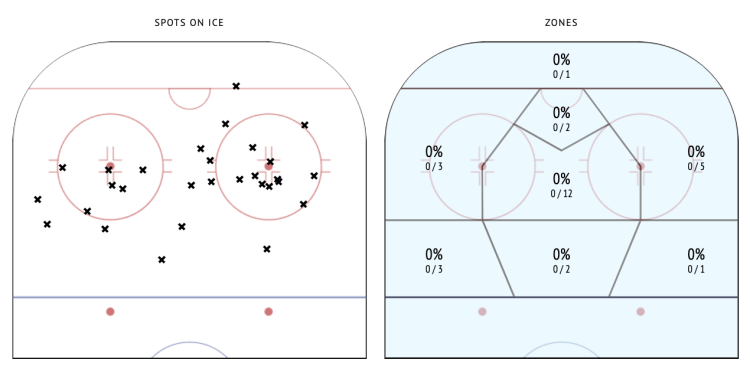
In terms of Svechkov’s shooting, he does struggle from range, but at the same point, he loves taking shots from range. In particular, he has the most amount of challenges when he is taking shots from distance on the right side of the ice in medium danger. The below shot maps from InStat Hockey accurately paint the picture.

Screenshot from InStat Hockey

Aside from his struggles in medium danger on the right side, he needs to improve his one-timer tracking and reaction timing. When he gets feed a juicy pass and appears that he wants to rip a one-timer, there are times where he misreads the timing and misses the puck completely. When Svechkov does find success and scores, more than often it comes when he is net front or in high danger.

From a skating perspective, Svechkov deploys a wide extension. He only needs roughly two extensions to get to his top speed. But, it’s not the just extension length that helps propel him, he also is a strong straight-line skater and has the ideal ankle flexion to get him moving. To kick things off when he grabs possession of the puck in his defensive zone, he uses strong crossovers to help navigate him and provide excellent acceleration. While his extension and acceleration are in fine form, he should work on developing his edges. At times, in the defensive zone, when the puck shifts around the zone and he shifts his body to face the puck, he appears to stomp with his skates instead of using his edges to make the quick pivot/turn. If he uses his edges, should he make the turn and he finds a loose puck to chase after, it is far better for him to be in motion than for him to power up and start from a side-by-side skate position. In addition, I have noticed that occasionally when he is deploying his reach, he will accidentally lengthen his extension too far out at the same time and lose possession of the puck.

Earlier, we briefly brought up Svechkov’s robust defensive play, but there is plenty to drool over. First of all, Svechkov is very aggressive to the puck, puts in the same amount effort in every single shift and can be very frustrating for anyone in possession of the puck. With his acceleration and speed, he is electric and will go after the puck no matter the zone.

In the defensive zone, he will do well under duress and can evade the forecheck with ease. He pivots out and wiggles his ways through. He also does a great job putting on the pressure and adjusting to puck movement on the fly. When positioning on the wing, he finds the perfect spot to be in to allow for quick movements when looking to shut down the cycle. If he is defending the rush and trying to keep his opponents in low danger, he deploys tight man on man defense to keep the opponent stuck along the boards.

In terms of his own puck movement and skating up the ice on the rush, sometimes he needs to be more cautious with his decision making. On occasion, he will have an attacker riding alongside him and he will look to deliver a pass through the attackers’ legs, he will misread how close the attacker is to him and cause a turnover. There are also times where he positions the puck too far wide, especially around the perimeter and drags the puck further out to low danger along the boards. If he keeps the puck tighter and closer to his body, he will have far more success and will be able to manufacture scoring chances in medium danger.

Even though there are moments where Svechkov does struggle with puck placement, he will deliver swift flicks of the puck from his backhand to his forehand when facing a defender at the opponent’s blue-line. The swift puck movements allows him to throw the puck towards the boards and swerve the puck around the defender. He also has outstanding reach, which we discussed when we brought up manipulation, but it also allows to him to avoid a sliding defender in a 2-on-1 situation. When he bypasses the sliding defender, he can then deliver a backhand pass or a tape-to-tape feed through the open lane.

Comparison

Jesse Puljujärvi, Right Wing, Edmonton Oilers

Given Puljujärvi’s excellent puck movement, acceleration and how dangerous he can be down low, it’s hard to find a better comparable for Svechkov. But, Svechkov needs to round out his shot from distance to measure up to Puljujärvi as the Finnish winger is stronger than Svechkov from distance.

Projection

Top Nine Winger with Top Six Upside (NHL)


stats from InStat and EliteProspects

Prospect report written by Josh Tessler. If you would like to follow Josh on Twitter, his handle is @JoshTessler_.

Looking for other scouting reports? Check out the Prospects tab for our other scouting reports.

Need a scouting report on a particular prospect, contact us today!
Winter 2021 NHL Draft Rankings

Photo Credit – Rena Laverty (Beniers & Hughes), Elvira Holmström (Eklund)

Bailey Johnson, Sam McGilligan, Alexander Appleyard, Paul Zuk, Sebastian Jackson and Josh Tessler combined their draft rankings and put together the official Smaht Scouting 2021 NHL Draft Winter Rankings.

The rankings are below and our scouting reports are hyperlinked. Just to note, Fwe are still working on some more 2021 NHL Draft scouting reports for public consumption. Stay tuned for those.

Just to note, honorable mentions are in no particular order.

PicksProspectPositionTeamNation
1Matthew BeniersCUniversity of MichiganUSA
2William EklundLW/CDjurgårdensSweden
3Luke HughesLHDUSNTDPUSA
4Simon EdvinssonLHDFrölundaSweden
5Fabian LysellLW/RWLuleåSweden
6Owen PowerLHDUniversity of MichiganCanada
7Brandt ClarkeRHDBarrieCanada
8Jesper WallstedtGLuleåSweden
9Aatu RätyCKärpätFinland
10Kent JohnsonC/LWUniversity of MichiganCanada
11Dylan GuentherRWEdmontonCanada
12Oskar OlaussonLW/RWHV71Sweden
13Cole SillingerLWMedicine HatCanada
14Stanislav SvozilLHDBrnoCzech Republic
15Carson LambosLHDWinnipegCanada
16Nikita ChibrikovRWSKA St-PetersburgRussia
17Isak RosénRWLeksandsSweden
18Simon RobertssonRWSkellefteåSweden
19Daniil ChaykaLHDGuelphRussia
20Dylan DukeLWUSNTDPUSA
21Sasha PastujovRWUSNTDPUSA
22Scott MorrowRHDShattuck-St. Mary’sUSA
23Brennan OthmannLWFlintCanada
24Zachary L’HeureuxLWHalifaxCanada
25Chaz LuciusCUSNTDPUSA
26Samu TuomaalaRWKärpätFinland
27Samu SalminenC/LWJokeritFinland
28Mackie SamoskevichRWChicagoUSA
29Logan StankovenCKamloopsCanada
30Xavier BourgaultCShawiniganCanada
31Francesco PinelliCKitchenerCanada
32Mason McTavishCPeterboroughCanada
33Matthew CoronatoLWChicagoUSA
34Ayrton MartinoLWOmahaCanada
35Aidan HreschukLHDUSNTDPUSA
36Anton OlssonLHDMalmöSweden
37Fyodor SvechkovCTogliattiRussia
38Trevor WongCKelownaCanada
39Zach DeanCGatineauCanada
40Zachary BolducCRimouskiCanada
41Sebastian CossaGEdmontonCanada
42Sean BehrensLHDUSNTDPUSA
43Artyom GrushnikovLHDHamiltonRussia
44William StrömgrenLWMODOSweden
45Jack O’BrienCPortlandUSA
46Justin JanickeLWUSNTDPUSA
47Tristan LennoxGSaginawCanada
48Benjamin GaudreauGSarniaCanada
49Peter ReynoldsCSaint JohnCanada
50Bryce MontgomeryRHDLondonUSA
51Jack BarRHDChicagoCanada
52Ty VoitFSarniaUSA
53Cameron WhynotLHDHalifaxCanada
54Jack PeartLHDGrand RapidsUSA
55Corson CeulemansRHDBrooksCanada
56Vincent IorioRHDBrandonCanada
57Marcus AlmquistRWHV71Denmark
58Prokhor PoltapovLWCSKA MoscowRussia
59Ryan UfkoRHDChicagoUSA
60Liam Dower NilssonCFrölundaSweden
61Evan NauseLHDQuebecCanada
62Liam GilmartinLWUSNTDPUSA
63Ville KoivunenFKärpätFinland
64Ryder KorczakCMoose JawCanada
65Redmond SavageCUSNTDPUSA
66Logan MaillouxRHDLondonCanada
67Roman SchmidtRHDUSNTDPUSA
68Samuel HeleniusCJYPFinland
69Martin RysavyFPrerovCzech Republic
70Victor StjernborgCVäxjöSweden
71Conner RouletteLWSeattleCanada
72Lorenzo CanonicaCShawiniganSwitzerland
73Jake MartinRHDUSNTDPUSA
74Justin RobidasCVal-d’OrCanada
75Robert OrrCHalifaxCanada
76James MalatestaLWQuebecCanada
77Oscar PlandowskiRHDCharlottetownCanada
78Vladislav LukashevichLHDYaroslavlRussia
79Verner MiettinenCKiekko-EspooFinland
80Dmitri KatelevskyFKazanRussia
81Jimi SuomiLHD/FJokeritFinland
82Hugo GabrielssonLHDFrölundaSweden
83Topias VilénLHDPelicansFinland
84Kirill GerasimyukGSKA St-PetersburgRussia
85Brett HarrisonCOshawaCanada
86Chase StillmanCSudburyUSA
87Wyatt JohnstonCWindsorCanada
88Viljami MarjalaFQuebecFinland
89Philip GranathRWFrölundaNorway
90Kirill KirsanovLHDSKA St-PetersburgRussia
91Eetu LiukasFTPSFinland
92Oliver MobergRWAIKSweden
93Brent JohnsonRHDSioux FallsUSA
94Maxim MotoryginGDynamo MoscowRussia
95Jeremy WilmerCUSNTDPUSA
96Ethan Del MastroLHDMississaugaCanada
97Cole HuckinsCAcadie-BathurstCanada
98Oliver KapanenCKalPaFinland
99Atte LehikoinenLHDKalPaFinland
100Niko HuuhtanenRWTapparaFinland
HMVsevolod GaidamakFOmskRussia
HMNicolaus HeiglFEC SalzburgGermany
HMThomas HeiglFEC SalzburgGermany
HMNoah MeierLHDGCK ZürichSwitzerland
HMJan-Luca MünzenbergerLHDKölner HaieGermany
HMBrady BurnsC/LWSaint JohnCanada
HMDavid GucciardiLHDWaterlooCanada
HMMartin SchreiberRHDLinköpingSweden
HMWilliam von BarnekowLW/RWMalmöSweden
HMLinus SjödinC/RWRögleSweden
HMSam SedleyRHDOwen SoundCanada
HMTheo JacobssonCMODOSweden
HMKalle VäisänenFTPSFinland
HMKalle ErvastiRHDLukkoFinland
HMDavid MaLHDChicagoUSA
HMRuben RafkinRHDTPSFinland
HMEthan CardwellRWBarrieCanada
HMDario AllenspachFZugSwitzerland
HMFlorian EliasCMannheimGermany
HMDmitri ZuganCCSKA MoscowRussia
HMVictor SjöholmRHDHV71Sweden
HMValtteri KarnarantaFÄssätFinland
HMElias StenmanCSkellefteåSweden
HMHaakon HäneltCBerlinGermany
HMBennet RoßmyFLausitzer FüchseGermany
HMKevin NiedenzRWKölner HaieGermany
HMSebastian CimmermanFRB Hockey JuniorsGermany
HMAlexander KisakovFDynamo MoscowRussia
HMTy GallagherRHDUSNTDPUSA
HMTristan BrozCFargoUSA
HMJoshua RoyRWSherbrookeCanada
HMDaniil LazutinCSKA St-PetersburgRussia

Scouting Report: Ryan Ufko

Photo Credit – Chicago Steel

Ryan Ufko is a 2021 NHL Draft eligible defenceman currently playing for the Chicago Steel of the USHL. He is considered to be a two-way defenseman with a lot of offensive potential. Ufko was born in Smithtown, New York, and played his most recent youth hockey for the North Jersey Avalanche 16U AAA in the Tier 1 Elite Hockey League, one of the more prominent youth leagues in the United States.

Ufko joined up with the Chicago Steel of the USHL to begin the 2019-20 season, and played fairly well, tallying two goals and seven assists for nine points in 43 games as a 16 year old. He was utilized mainly in even strength situations as a 16 year old, only averaging a touch over 13 minutes of ice time in his first season. However, his game has skyrocketed in 2020-21, as he’s seen an incredible increase when it comes to ice time (avg. 24:37 min/game) both at even strength and on special teams (avg. 5:02 min/game PP, 2:41 min/game PK).

Ufko has also excelled at the offensive portion of his game this season, as he’s seen his point totals almost triple thus far in half as many games played. As of February 1st 2021, Ufko has recorded seven goals and 19 assists for 26 points in 26 games. He’s also averaging just over 3.5 shots a game, more than double the shots he recorded in 19/20 (1.23 shots/game).

Ufko is committed to the University of Massachusetts-Amherst for the 2021-22 season, where he’ll hone his skills under Coach Greg Carvel. If anyone can help develop Ufko’s all around game while keeping his offensive prowess alive, it would be Carvel. His UMass Minutemen teams have produced some talented offensive defensemen as of late, most notably Colorado Avalanche Defenseman, Cale Makar.

Player Profile

D.O.B – May 7th, 2003
Nationality – American
Draft Eligibility – 2021
Height – 5’10”
Weight – 181 lbs.
Position – Defence
Handedness – Right

Ufko’s Style Of Play

Ufko has definitely upped his game since joining the Steel in 2019/20, enough that NHL Central Scouting has given him a “B” rating in it’s most recent “Players To Watch” list. Ufko was recently named USHL Defenceman of the Week, the second time he’s earned the honour in 2020/21. He’s made great strides in improving his game in all three zones, but perhaps most noteworthy is his offensive zone play. As mentioned above, he’s seen his point totals skyrocket, and can also be counted upon to eat minutes off the clock. Ufko also excels in the transition game, as he can quickly change direction and hop into the rush following a turnover. He also showcases his ability to be physical, when needed:

On the defensive side of things, Ufko tends to stay in position fairly well, albeit he does jump up in the play quite often. Besides that, he has good gap control and can push defenders out wide and shut down zone entries quite effectively. Ufko is also decent at breaking up the opponents cycle down low, by utilizing his very active stick.

Let’s take a dive into the finer aspects of Ryan Ufko’s game:

Skating

Ufko’s skating is one aspect of his game that could use a little work. While he doesn’t possess blazing speed or a short, fast stride, Ufko can keep with the pace of play in all zones of the ice. He’s also capable of keeping up with his teammates in transition. Ufko’s agile enough to be effective in all zones of the ice, but seems to lack that burst of speed that many NHL level two-way defenceman have. However, Ufko is good on his edges, as he can quickly change direction to help on the attack or to cover off for his defense partner.

There’s a little room for improvement when it comes to Ufko’s skating, as he would benefit greatly from working on his explosiveness to help when he’s in transition, as well as hustling back into position after he rushes up ice. Ufko could also benefit from getting a lower center of gravity in stride, as he tends to have a more upright skating stance.

Offence

Without a doubt the most improved part of his game, Ufko has put up staggering numbers as a 17-year old this season. He’s certainly developed a knack for jumping up in the rush, or pinching down into the corners in the offensive zone, thus giving him plenty more chances to score or set up his teammates. Speaking of setting up his teammates, Ufko is a very talented playmaker. He has great vision on the ice when it comes to making a breakout pass, or setting up a teammate for a one-timer, or generating a scoring chance from down low. Ufko’s also not afraid to shoot from just about anywhere on the ice surface, as he’s been successful pretty much anywhere getting pucks on net.

Ufko is an above average passer of the puck, capable of making the simple passes with ease. He is also able to successfully make stretch passes to create odd man rushes a few times per game. Most NHL scouts will enjoy his game footage, as he doesn’t seem to be afraid to take chances and create offence, regardless of the game situation.

Defence

Ufko is a very adequate defender, especially when it comes to fending off attacking players in his own zone. Perhaps his most impressive trait is his active stick, which he utilizes very well. Ufko is a fairly talented penalty killer in his own right, as he usually sees just under 3 minutes of PK time per game. He’s quite good at holding on to the puck and then hitting a teammate in stride for a shorthanded rush. As mentioned above, Ufko is able to push defenders out wide and shut down zone entries.

In watching film of Ufko, his defensive game seems to have taken a back seat this season in terms of development. That’s not to say it’s worsened, but it’s stayed put. At times, he seems to be rushed when sustained pressure is applied, and can make little mental mistakes leading to scoring chances. Perhaps it’s a stamina issue, due to the fact he’s chewing a lot of minutes off the clock, but that usage will change most likely at the NCAA/NHL level.

If Ufko can hone his defensive zone skills as quckly and as positively as he has his offensive zone talents, he’ll be able to develop more into that two-way defenceman he’s striving to be.

Improvements

While Ufko has seen alot more work this season in the defensive zone (~56% of ice time), there are still aspects of his game which could use some attention. For example, when Ufko jumps up into the rush and the Steel turn the puck over, he can be a little lackadaisical on the backcheck. This, of course, leads to an odd man rush for the opponent more times than not.

Another aspect of Ufko’s game that can be improved on is his net front physicality. In watching footage from the past two seasons, Ufko can be a little passive at times when it comes to tying up attackers in front of the net. In these instances, it has led to a goal allowed more often than not. Little lapses in judgement when it comes to tracking the puck in the defensive zone have also been spotty at times. Occasionally, Ufko has chased after a loose puck, in which was recovered by the attacking team and a scoring chance was given up.

Although these issues seem glaring, Ufko is still capable of correcting them and rounding out his game. He could benefit from landing with a team and coaching staff/front office who is willing to let him work through the kinks and learn on the fly.

Overall Outlook

If an NHL team is looking for a project of sorts, and is in search of a talented two-way defenceman, Ufko is your man. He provides great offensive output for an undersized defenceman, and is a very good playmaker. On top of that, he boasts above average wrist and slapshots, and can get a puck through tight windows given the opportunity.

Ufko has the potential to become a two-way threat with a little more work on his skating, defensive zone decision making, and net front physicality. If he can improve on these in the near future, especially next season at UMass-Amherst, there’s a fairly good chance he’ll find himself suiting up for an NHL team in the seasons to come.

Comparison

Tyson Barrie, RHD, Edmonton Oilers

When you look for an NHL comparable for Ufko, the first name that comes to mind is Tyson Barrie. While Ufko has just a little more physicality in his game, they are quite similar players. Both Barrie and Ufko are on the smaller size of what you’d expect an NHL-level defenceman to be, but they both make up for it with their offensive talent. Barrie and Ufko also see the game very well and tend to make good decisions in all zones of the ice. While Ufko has some defensive zone work to improve on, teams should still take a deeper look into his game. If he can develop his game to model someone like Tyson Barrie, the team that selects him would certainly be thrilled.

Projection

The 2021 NHL Draft is loaded with talented, promising defensive prospects. While Ufko is definitely among that crop, the kinks in his game may have his draft stock fall a little bit. That being said, look for Ryan Ufko to be selected somewhere between Picks 35-45, early in the Second Round.


stats from InStat and EliteProspects

Prospect report written by Paul Zuk. If you would like to follow Paul on Twitter, his handle is @paulzuk_81.

Looking for other scouting reports? Check out the Prospects tab for our other scouting reports.

Need a scouting report on a particular prospect, contact us today!

Scouting Report: Cole Sillinger

Photo Credit: Robert Murray / WHL

I can’t imagine that Cole Sillinger ever expected his draft year to play out the way that it has. The former 11th overall pick in the 2018 WHL Bantam Draft and son of former NHLer Mike Sillinger certainly expected to play the most important season of his junior career with the Medicine Hat Tigers, especially after his incredible rookie season where he accrued 53 points in just 48 games played (1.10 ppg). Sillinger was on fire last year, constantly showing signs of improvement as the season progressed until an unfortunate UBI caused him to miss four weeks of play. Despite the missed time, he came back from injury without missing a beat and went right back to his upwards trajectory of getting better with every game. Just as he was really starting to put it all together, the WHL season came to an abrupt end due to the COVID19 pandemic and Sillinger’s impressive rookie season had come to a close.

Fast forward to 2021. The WHL, as well as the OHL, have still yet to announce their plans for the 2020-21 season leaving all of their prospects in limbo. Do draft eligibles wait around, hoping that their respective leagues figure out a plan for them to get back on the ice? Or do they look elsewhere, hoping to transfer to a league where they can get any sort of regular playing time in such a vital year in their careers? Cole Sillinger made the decision to play elsewhere, and now he’s begun playing his draft year in a league he never expected to, for a team he never expected to play on: the Sioux Falls Stampede of the United States Hockey League. The transfer was completed on January 13th 2021 and, at the time of writing this article, Sillinger is nearly maintaining a goal per game pace with 7 goals and 12 points in his first 8 games.

Player Profile

D.O.B – May 16, 2003
Nationality – Canada
Draft Eligibility – 2021
Height –6’0
Weight –187 lbs
Position – Center
Handedness – Left

Sillinger’s Style of Play

Like most junior hockey superstars Cole Sillinger is a player who wants to score goals and see that lamp light up. He has the means to do so as well, as he boasts a quick release that generates a ton of velocity with very little sacrifice in accuracy. He exhibits great placement of the puck and can hit small gaps from nearly anywhere on the ice. His shooting arsenal isn’t limited by any means as he can easily beat goalies with a snap shot, a wrist shot or a one timer. He demonstrates deception by combining numerous body fakes, look offs and skill moves to create his ideal shooting lanes. In addition, he hides his shot well, masking his intentions until the very last moment where he can open/close the blade and change the angle with a subtle weight shift, all during his very brief shooting motion. He loves shooting the puck mid drag, simultaneously threatening both a pass and a shot so that the goalie can’t fully commit to the shot. While his shot is dangerous in many ways, what really elevates Cole’s game to the next level is his propensity to hunt for medium/high danger chances over low danger shots. You won’t often see Cole blindly firing pucks from awkward angles along the perimeter or from far away at the point. Instead, you’ll see Cole advance into medium/high danger areas with the puck, often using well timed cuts, crafty footwork and a wealth of skill moves to get by his defender and fire a rocket on the net. 

Sillinger is more than a pure goal scorer, he’s also proven to be a dangerous passer in all areas of the ice. He doesn’t just mindlessly give the puck away when he can’t find a shooting lane, he times his passes so that they’re often received in stride surrounded by an open pocket of space. He understands the value of drawing in defenders before passing the puck to a teammate in order to create more space around the ice. While not overly physical, he doesn’t shy away from contact in order to make the best play available. I’d go as far as to say he even has some chippiness in his game. He can maintain puck control through contact, and tries to gain body position so that he has leverage in his physical encounters to push off stronger opponents. Just like with his shooting habits, Sillinger’s priority when passing is to find a teammate in medium/high danger areas and get them the puck. He doesn’t try to force the pass if the lane doesn’t exist and will often cutback and reset looking for the next play to make. He has an eye for tight, narrow lanes that only exist for a few moments and can seamlessly thread passes that are easily controlled by the recipient. His passing is not limited to just forehand moves as Sillinger has shown he can still move the puck through the lanes on his backhand. He could stand to do this more, it never hurts to make the defence respect one more weapon. 

Whether it’s with the puck on his stick or he’s following his team into the zone, Sillinger is a very active player in transition, When he has the puck you can expect Cole to use crossovers to quickly change his routes as he attacks the zone, often blending his footwork with other manipulative techniques such as look offs and hesitation moves to make his opposition indecisive as he enters the zone. When away from the puck he picks his routes carefully, trying to cross the opposing blue line in a spot where he can support his teammate. He’s effective in give and go situations, often demonstrating that he understands how to utilize his teammates close to him to maintain controlled possession in zone entries. He tends to draw defenders into him, faking an attack to the outside lane before quickly cutting towards the middle and gaining the zone from there. Sillinger can identify when his teammate will enter the zone with little resistance and create a cross ice lane to get him the puck. He’s not perfect in transition, as he sometimes gains the zone with the intention of taking the outside lane and blowing by his defender without the top line speed to actually do so. Other times you may find Sillinger attack the zone and find himself driving right into pressure with no way out other than to dump the puck or surrender possession to the opposition. While this is concerning, it’s possible this method of attack could be a legitimate weapon if he can improve his top speed. Even if he can’t, Sillinger has already demonstrated that he doesn’t rely on one method of attacking the zone so it isn’t unreasonable to expect more refinement in his decision making in regards to transition. 

When a player is very clearly the best player on the ice with every shift they take, you may find that their effort level decreases when the puck isn’t on their stick. Some players never develop good off puck habits to support their teammates when they aren’t the ones driving the bus. They tend to not move their feet much and float around, or they don’t put in effort when chasing the puck outside of their reach. These players tend to have a hard time when transitioning to higher level hockey as understanding how, when, and where to move away from the puck is a necessity in order to be an effective player in all 3 zones of the ice. Thankfully, despite being the best player every time he steps on the ice, Sillinger continues to demonstrate quality off puck movement. He races on retrievals, forcing defenders to go at 100% to stop Cole from sneaking by them and grabbing the puck behind the net. When the puck is wedged under multiple bodies fighting along the boards, Sillinger tends to sneakily wait around until the perfect time to come in and steal the puck. He’s always trying to be an open outlet option for teammates under pressure. When his teammates gain the zone, Sillinger times his movements into open lanes so he can either fire the puck without breaking stride or quickly identify a teammate in a dangerous opportunity and move the puck onto their stick. He shows no difficulty making plays in motion but can also enter a glide and make plays w/ the game slowed down. Sillinger plays with a high pace, something that projects well considering how fast the game is played at the NHL level. 

Sillinger employs his off puck play to be a capable defender too. In the neutral zone, he positions himself to be able to retrieve loose pucks or steal a puck that’s been knocked away from the other team. He trails attackers as they attack the zone and uses his stick to interrupt the play if the opposition slows down or forgets about him. He uses his stick intelligently when defending against transition, often breaking down plays that come within his vicinity. He could stand to gamble less on his reads in transition and make smarter, efficient plays more often. He has shown the capacity to make these higher IQ reads so the potential for further development is there. He plays a safer game in the defensive zone. He still occasionally misreads and over commits on certain plays (especially on the penalty kill, he shouldn’t be out there at 5v4) but again, he’s shown repeatedly that he is capable of being a valuable contributor defensively so it’s possible for consistency to be developed here with more experience. Like in the offensive zone, he can position himself accordingly so that he’s an open outlet for when possession is regained. He’s also capable of discerning when to jump into a scrum and try to steal the puck. While his effort in the defensive zone isn’t as consistent as his effort in the offensive zone, there’s no denying that he understands how to be a competent defender and what his role is. You can often catch him scanning around the defensive zone, keeping track of where the opposition is. He’s showing flashes of knowing when to pressure forecheckers, when to retreat back towards the blue line, when to come low to support his defence and when to get his stick/body in passing lanes to shut them down or intercept the puck. I’ve yet to see many shifts where he displays all these attributes in succession but the individual skills are there and, with the right development, could come together to be a good supporting defensive winger at the NHL level. 

One could argue that the biggest question mark for Cole Sillinger is his skating. There’s notable improvement between the WHL shut down and his arrival in the USHL but it’s still among his weaker attributes. He could stand to improve his two step acceleration as being able to consistently gain separation from his opponents from a stopped position would make it much easier to attack pockets of space. As mentioned before, he does utilize crossovers when attacking laterally through the NZ to keep defenders moving their feet. He combines strong edgework with a lower center of gravity to shield the puck from bigger opposition, while also displaying sharp cuts and pivots to quickly slide through narrow gaps. His top speed is lackluster, but he has shown improvement between last year and now so there’s room to reasonably believe he’ll continue to improve. He needs to display better ankle flexion, moving his knees farther over his toes in order to maintain better skating form. It can help generate a stride that is more powerful with longer, deeper extensions thus providing improvements in both explosivity and top speed. With that being said, Sillinger makes up for his lack of elite skating with high level deception and manipulation. The modern day NHL is about creating space all over the ice through active off puck movement and while elite skating is a very valuable tool in doing so, it’s not a necessity. While skating is becoming more and more valuable with each draft that passes, it’s not a necessity if the player exhibits traits and skills that help them find space regardless. Sillinger does possess a wide variety of these traits and with further refinement in how each tool is used in conjunction with the rest of his toolkit, it’s easy to see how his elusive behaviours would translate to the NHL.

I really like Cole Sillinger. It took me a few games as I initially misread his off puck movement as “laziness” or “coasting”. There were some times he really frustrated me as there were opportunities to make high level plays that he passed up on for low probability 1 on 1 encounters. I was seeing the talent but was questionable on his decision making. The more I watched, the more I realized that he can actively contribute in all three zones. Upon rewatching the first few games where I had come away unimpressed, I realized even in these games how his off puck movement and desire to attack open space were creating chances over the ice. He’s certainly too good for the USHL and would benefit from playing against better opposition for the sake of his development. All in all, in a draft that severely lacks high octane, dynamic offensive talents Cole Sillinger stands out as one of the top forwards and should certainly be ranked in the lottery for the 2021 NHL draft.

Comparison

Mark Scheifele, Center, Winnipeg Jets

Being one of the more unique players in the draft, Cole Sillinger tends to remind of Mark Scheifele. Both players had questionable skating at the time of their draft but made up through it with deception, a tendency to hunt for open space, strong off puck play and an eye for narrow passing lanes.

Projection

Middle six forward, likely winger with 20 goal potential and 30 goal upside.


stats from InStat and EliteProspects

Prospect report written by Sam McGilligan. If you would like to follow Sam on Twitter, his handle is @Sam_McGilligan.

Looking for other scouting reports? Check out the Prospects tab for our other scouting reports.

Need a scouting report on a particular prospect, contact us today!

Scouting Report: Kent Johnson

Photo Credit – Trail Smoke Eaters / Mike Hockley

It’s not hyperbolic to say that no one has lit up the BCHL in their draft-minus-one year like Kent Johnson did last season. After putting up 46 points in 57 regular season games with the Trail Smoke Eaters as a 16-year-old and adding another 12 in 12 playoff games, Johnson exploded in his 17-year-old season for 101 points in just 52 games. The playoffs were cut short due to the pandemic, but before the season ended, Johnson added seven points in four playoff games.

You have to look all the way back to Scott Gomez in 1997 to find a player that tops Johnson’s 1.94 points per game pace. All of that is to say that, at only age 17, Johnson was far and away the best forward in the BCHL last year and one of the best in the last 20+ years.

Through the first part of first NCAA season, Johnson is tied for the team lead with 18 points in 16 games. Despite playing center in junior, he’s mostly played the left wing with Matty Beniers as his center on Michigan’s top line. Johnson did center a line while Beniers was at the World Junior Championships to limited success but given that the Wolverines were swept in that series, it’s hard to draw conclusions about how impactful he would be at center in the NCAA based on that sample.

Player Profile

D.O.B – October 18, 2002
Nationality – Canada
Draft Eligibility – 2021
Height –6’1
Weight –165 lbs
Position – Center/Left Wing
Handedness – Left

Johnson’s Style of Play

Johnson is as creative as they come. Whether it’s passing and shooting between his legs, lacrosse moves, or anything else you’d find on a highlight reel, if you can dream it, he can probably do it. Michigan coach Mel Pearson has a longstanding philosophy of allowing his skilled players freedom to exercise their creativity, and Johnson has undoubtedly benefited from that thus far. More of a playmaker than a goal-scorer, Johnson’s passing stands out on almost every shift, whether he’s sending a spin pass to a teammate wide open in the slot or finding a lane between three defenders.

Johnson’s hands have always been a calling card of his, and they’ve certainly been on display so far in his NCAA career. Look no further than this clip for a microcosm of who Johnson is:

The between-the-legs shot is the obvious highlight, but it’s the sharp cutback along the wall that gets him the space to attempt the move in the first place. If you watch even one of Johnson’s games, he’ll probably cut back like that at least four or five times, if not many more. At the NCAA level, Johnson isn’t the fastest skater in a straight line (though his straight-line quickness is very solidly above average) but his edgework and shiftiness make him incredibly elusive. Playing the wing has been an adjustment for Johnson, between having the puck less and being more on the wall than in the middle of the ice, and I’d like to see him continue to focus on getting off the wall more. That’s something he’s aware of and mentioned working on in a January interview.

“I think I play best when I have the puck on my stick a lot in the game, especially in the neutral zone and the offensive zone,” Johnson said. “… At first, I just had to find a way to get the puck a bit more because obviously a lot runs through the center a lot of the time. Just trying to find a way. For me, just getting off the wall early when I do have the puck — at this level, I’m not the fastest guy yet so I can’t really just bust down the wall with speed, so I’ve gotta get off the wall so I can use my shiftiness and my IQ. Whenever I get the puck, I try to take a step to the middle now.”

If you’re looking at Johnson on paper, his point totals stand out — above point-per-game pace in the NCAA is pretty striking for a draft-eligible player. But if you dig deeper, 11 of those points are secondary assists. He’s scored six goals, which ranks second on the team, and most strikingly, he has just one primary assist on the season. Johnson doesn’t shoot the puck a ton — his 29 shots rank him eighth among the Wolverines — but he leads the team with a 20.7% shooting percentage, so he’s clearly efficient when he does shoot. I’d like to see him shoot the puck a little more in Michigan’s remaining games, because if there’s one thing to nitpick in his game, it’s his occasional tendency to pass up a shot in favor of looking for the perfect passing option.

Let’s talk a little more about all those secondary assists for a second. I like to use secondary assists as an indicator that the player is driving offense when his team is on the ice rather than a demonstrator of particular skill, because secondary assists are often coincidental. Though I’d like to see Johnson put up more primary points like he’s certainly capable of doing, Johnson’s high point totals indicate that he drives offense when he’s on the ice, and that’s undeniably valuable.

On his line with Beniers, Beniers is often the one doing the so-called dirty work, and Johnson consistently demonstrates a strong understanding of positioning and puck support. It seems like he’s nearly always in the right place to receive an outlet pass and start the breakout or take the puck into the offensive zone himself. Per Madeline Campbell’s tracking, Johnson has more zone entry attempts than anyone else on Michigan by a wide margin with 106 — the next closest is 89. He’s successful with his high volume of zone entries, too, with a 73.3% controlled entry percentage. When exiting the defensive zone, Johnson is second among Michigan’s forwards in exit attempts and has a 66.2% controlled exit percentage. Combine that with his effectiveness in entering the zone and you begin to get a picture of Johnson’s efficiency and skill in transition.

From a defensive standpoint, Johnson pretty much just does what he needs to do. He may not win any awards for his defensive play, but he’s not a liability in his own end. The best defense is not having to play in the defensive zone at all, and his line is seemingly always in the offensive zone. In the two games where he played center and had to take on more responsibilities in the defensive zone, he was relatively effective against a high-powered Minnesota offense and seemed to get comfortable quickly with having more defensive responsibility. The same skills that make him effective in transition — most notably his sound positioning — make him effective in the defensive zone as well.

Improvements

Obviously, at just 165 pounds, Johnson needs to add strength. He plays bigger than he looks on paper — it’s relatively rare to see him get blown off the puck or be completely overwhelmed in a puck battle — but adding weight to his frame will be important for his success at the next level. Everything else is somewhat nit-picky, but as mentioned above, I’d like to see him shoot the puck more and work more on getting to the middle of the ice. He can occasionally get a little stuck on the wall, and attacking the middle of the ice, whether in transition or in the offensive zone, will help him create more space to make more plays.

Comparison

Alex Newhook also scored 100+ points in the BCHL, though he did it in his draft year as opposed to Johnson his D-1 year. Newhook went on to be drafted at No. 16 overall by the Avalanche in 2019 and put up 42 points in 34 games for Boston College as a freshman last year. But stylistically, Johnson is more similar to Mitch Marner — both slightly undersized, high-level playmakers with quick hands and shifty feet.

Projection

As high as a top-line center/winger (NHL), floor is a top six forward (NHL).


stats from InStat and EliteProspects

Prospect report written by Bailey Johnson. If you would like to follow Bailey on Twitter, her handle is @BaileyAJohnson_.

Looking for other scouting reports? Check out the Prospects tab for our other scouting reports.

Need a scouting report on a particular prospect, contact us today!

Scouting Report: Zach Dean

Photo Credit – Olympiques de Gatineau

Zach Dean is a 2021 NHL Draft eligible prospect and plays for the QMJHL’s Gatineau Olympiques. He was born in Grand Prairie, Alberta (northwest of Edmonton and roughly an hour and a half drive time from Dawson Creek, British Columbia).

Eventually, the Dean family moved to Mount Pearl, Newfoundland and Dean played youth hockey for Mount Pearl MHA. After his time with Mount Pearl MHA, he played for Tri Com Bantam of the NLBAAAHL and the GTHL’s Toronto Nationals U16 AAA.

He was selected fourth overall in the QMJHL Entry Draft by Gatineau and completed his QMJHL debut season last year (2019-2020). In 57 games played, he tallied 18 goals and 28 assists.

This past season, Dean has played in 20 games for Gatineau and has recorded ten goals and ten assists. He missed four games at the beginning of the season due to a wrist injury.

Player Profile

D.O.B – January 4, 2003
Nationality – Canada
Draft Eligibility – 2021
Height –6’0
Weight –176 lbs
Position – Center
Handedness – Left

Dean’s Style Of Play

Dean is a playmaker with strong stick-handling skills, a good power stride and a solid backhand shot.

When you watch Dean’s game-tape, you will notice immediately that he is a quality stick-handler and can complete windmill stick-handling with ease. He will often utilize his stick-handling each and every shift. In the offensive zone, Dean will use his stick-handling in anticipation of complete a tape-to-tape pass, in medium danger situations where he is trying to cut past the last defender to get into a high danger situation and to frustrate the opposing goaltender and catch him off guard. With that being said, his reach when stick-handling is limited and if he tries to push the puck further out he will have puck security issues. Also, if Dean tries to get a little fancy and flashy with his stick-handling, he will cough up the puck. There have been instances where Dean will attempt to dangle through his legs, but will fail to recapture the puck afterwards due to his limitations with his reach.

Given his affinity for stick-handling, it makes a lot of sense that Dean tends to favor backhand shooting and backhand passing. In fact, most of his shots from down low are backhand shots. Dean has range on his backhand and he can get backhands shots from medium danger on net. Prior to shooting, you will see Dean complete a windmill, get the puck on his backhand and then try his luck. Earlier on in the 2020-2021 season, we saw Dean use multiple windmills against the Shawinigan Cataractes to throw the goaltender off and the find the five hole for a backhand shot goal. While he does take a lot of backhand shots from the perimeter towards the low slot, he does opt to take plenty of wrist and snap shots from low danger. At low danger, he will take plenty of wrist and snap shots, but his selection is far from perfect. He often will choose moments in which he is facing tough pressure and should pivot out or button hook, but instead he will take an ill-advised shot. The majority of his low danger shots don’t get a ton of elevation and the goaltender can make a clean stop.

One of the areas that needs further development is his decision-making. Sometimes Dean will see three teammates battling in the corner of the defensive zone for the puck and instead of planting himself at center ice to eliminate a potential open lane, he will join the party which could lead to his opposition scoring should they win the puck battle and find a teammate in the slot. Dean also faces challenges with quick thinking. If a defenseman slides in front of him, he stumbles and carries the puck towards low danger instead of using his stick-handling skills to evade the defender and skate towards the doorstep.

When it comes to his transitional game, it’s pretty solid. Given Dean’s power stride and crossovers, it typically takes three lengthy extensions for him to generate top speed. So, if Dean is not facing a tremendous amount of pressure in the neutral zone, he can navigate through with ease. But, when facing tighter pressure, he will struggle. He will test his reach and motion the puck further out to stick-handle around traffic, but due to puck security he has challenges with keeping possession. Dean will also have challenges with his edges, especially when using his inside edge to make a quick pivot and turn. Aside from his edges, Dean does struggle on the rush when facing pressure from a defender who is bigger than him. He will struggle to out-muscle the defender and lose possession of the puck along the boards. The goal should be for Dean to work on his upper body strength and further develop his reach. If he does, his stick-handling skill-set will only lead to plenty of successful rushes.

His defensive game is another area that needs further development. He will struggle at executing pressure and often will give up too much room for his opposition to take advantage. Dean needs to exert more pressure in the neutral zone and defensive zone. If not, it will only lead to many scoring chances for his opponents.

From a passing perspective, as I noted above, he will use his stick-handling as part of his wind-up in tape-to-tape passes. But, on occasion, you will see Dean approach a pass as if he is completing a snap shot. He will extend the leg and gather power, but will over-shoot the intended target. But for the most past, his passing is pretty crisp and will sometimes look to utilize his backhand in transition. He will look to make quick backhand zone exit passes.

In the offensive zone, he is quick to puck battles and can hold his own in battles against players with a similar frame. But, when in control of the puck, he likes to carry the puck around the back of the net, go to the right ride, drop a well-timed pass and shift back to the left side of the offensive zone. Given Dean’s stick-handling ability and speed, once he gains some upper-body strength and adds to his reach, he could be a handful on the cycle.

Comparison

Ryan Spooner, Center/Left Wing, Dinamo Minsk, Played for four NHL clubs (Boston Bruins, New York Rangers, Edmonton Oilers and Vancouver Canucks)

Spooner and Dean are very similar in size. During his junior hockey days, it was evident that Spooner needed to beef up his strength, but he came in clutch with his backhand shot and stick-handling. While a Spooner comparison might seem to be an eye-opener given that he is now playing in the KHL, it shouldn’t be. Spooner had the necessary fundamentals to be a successful top nine forward in the NHL, but concussions changed the way that Spooner approached the game. I just want to be very transparent as I’m not saying that Dean’s NHL career will be as short as Spooner’s.

Projection

Top Nine Center (NHL).


stats from InStat and EliteProspects

Prospect report written by Josh Tessler. If you would like to follow Josh on Twitter, his handle is @JoshTessler_.

Looking for other scouting reports? Check out the Prospects tab for our other scouting reports.

Need a scouting report on a particular prospect, contact us today!

Scouting Report: Prokhor Poltapov

Photo Credit – CSKA Moscow/@HCCSKA

Prokhor Poltapov is a 2021 NHL Draft eligible prospect playing the CSKA Moskva farm system. He hails from St. Petersburg, Russia and played youth hockey for Serebryanye Lvy St. Petersburg and Dynamo Moskva. Last season, he made the short trek across Leningradsky Avenue and joined the CSKA Moskva organization. Poltapov split his time between CSKA’s U17/U18 teams and their MHL club, Krasnaya Armiya Moskva.

This season, Poltapov has appeared in 46 games for Krasnaya Armiya Moskva and has recorded 20 goals and 16 points. At the moment, Poltapov is in the top 20 for points in the MHL, but is not the leading 2021 NHL Draft eligible prospect in points. Fellow 2021 NHL Draft eligible prospect Alexander Kisakov of MHK Dynamo Moskva leads the league in points with 58. While there is a sizable point differential, it is worth noting that Poltapov is in top 10 for goals scored with 20.

Player Profile

D.O.B – February 1, 2003
Nationality – Russia
Draft Eligibility – 2021
Height –5’10
Weight –161 lbs
Position – Center/Right Wing
Handedness – Left

Poltapov’s Style Of Play

Poltapov is a power forward prospect with explosive speed and has a knack for finding open lanes in the slot, which makes him a handful when Poltapov and a teammate are on a 2-on-1 rush. Poltapov excels at driving hard to the net. He lives for causing chaos in the slot.

Not only does Poltapov find open lanes and gaps consistently, but he has underrated hands and has solid reach when stick-handling. He also uses his ability in finding gaps to find tight lanes that can he exploit with quick and crisp threaded passes right through those gaps.

In general, he tends to play more at right wing, but Krasnaya Armiya Moskva has battle-tested him at center. Given his dominant speed and strong defensive awareness, Poltapov was worth a shot at center and hasn’t missed a beat when shifting from wing to center.

When it comes to stick-handling, Poltapov has excellent reach. He can swing the puck far away from an attacker and ensure strong puck security. His upper body strength allows him to maneuver the puck around tough pressure with ease and he uses that same upper body strength to drive past defenders. Check out the first 14 seconds of the below clip to see Poltapov’s stick-handling in action.

Poltapov’s upper body strength on the rush allows him to push the neutralize the pressure by pushing the defender closer and closer to the slot. He can also use his upper body strength and reach to collect passes that went slightly off-target. It’s not a given that Poltapov can collect every off-target pass, but the fact that he can use his reach to grab a hold of a few is interesting to note. It eliminates the amount of loose pucks, interceptions and turnovers that Krasnaya Armiya Moskva has to deal with.

What I really like about Poltapov is his ability to read his opponents and adjust strategy on the fly. If his defensemen have pinched up, he will drop back to the blue-line and cover for them. If a few of his teammates are involved in puck battles along the boards and no one is manning center ice, Poltapov will sit at center ice to try to circumvent a potential pass to an attacker in the slot. In those situations where he is chasing down a loose puck in his own zone, he will have a good read of who is chasing the puck with him. Once he has possession of the puck, he won’t button hook because he would immediately face attackers head on. Instead, he will identify a teammate on the opposite half-wall and play the puck off the boards, so that his teammate can grab possession on the other side.

While I do like Poltapov’s ability to shift gears on a dime, there are some question marks with his play. Poltapov has a tendency to complete a drop pass without truly assessing the situation. There are times where he will pin-point the teammate that he wants to pass to, but does not keep an eye on an attacker bursting into the zone. The attacker will jump into Poltapov’s own zone and intercept the puck. Poltapov needs to take the time to scan more than just his teammate in order to eliminate costly turnovers.

In addition, on a dump and chase, he typically will not go hunting in the trenches and corners for the puck. Instead, he will opt to sit at the blue-line with his defensemen to create a three man wall. Poltapov should be looking grab some open ice closer up to the net and giving his teammates an option in the slot should they grab possession off the dump and chase. I also find it interesting that Poltapov will flip on the jets to chase a loose puck, but is less eager to forecheck on a dump and chase. But, with that being said, it isn’t odd to see Poltapov struggle on the forecheck. When he does go out on the forecheck, he is often too late and the attacker who he is charging after has already passed the puck to a fellow teammate. With Poltapov’s ability to turn on the motor, he should be working on acceleration when going on the forecheck. Without ironing out his acceleration on the forecheck, he will struggle at the NHL level.

Poltapov does struggle at times with his attackers forechecking/back-checking and putting pressure on him while he is along the boards. Instead of pivoting out of pressure, he freezes and can’t identify a way to get around traffic and keep the play alive.

From a skating perspective, he does struggle with quick pivots, but he displays quality edges and crossovers. He can accelerate quickly to dart after loose pucks. His extensions allow him to power up quickly with two-to-three power skating lengthy extensions, but sometimes he has difficulty with over extending his leg and will fall from time-to-time.

Lastly, Poltapov has shown that he can elevate shots from up close. But, what I really like about his shot is that he can be deceptive with his movements leading up to the shot. For example, at the doorstep, he will skate from left to right and then fire a backhand shot five hole. Poltapov can draw net-minders in and then pick the most ideal moment to strike. It’s sleek and well-timed. It’s natural for Poltapov.

Comparison

Blake Coleman, Center, Tampa Bay Lightning

Poltapov is around the same size as Coleman and plays a very similar game. Both players are power forwards who have explosive acceleration when chasing after loose pucks. Coleman and Poltapov also have excellent reach and stick-handling, so they can evade attackers with ease.

Projection

Top Nine Winger (NHL).


stats from InStat and EliteProspects

Prospect report written by Josh Tessler. If you would like to follow Josh on Twitter, his handle is @JoshTessler_.

Looking for other scouting reports? Check out the Prospects tab for our other scouting reports.

Need a scouting report on a particular prospect, contact us today!

Scouting Report: Artyom Grushnikov

Photo Credit – CSKA Moskva/@HCCSKA

Artyom Grushnikov, a 2021 NHL Draft eligible prospect, is a 17-year-old defenseman currently on the roster for the Hamilton Bulldogs of the OHL. Due to COVID-19 playing the main role in delaying all OHL play this season, Grushnikov has yet to take the ice in the 2020-21 season. Grushnikov was born in Yegoryevsk, Russia, and played the majority of his youth hockey in the Khimik Voskresensk system. Notable players to suit up for the Khimik Voskresensk youth system include Vladislav Namestnikov, Andrei Markov, and Igor Larionov.

For the 2017/18 season, Grushnikov joined up with the CSKA Moskva Under 16’s. Throughout his minor hockey career, Grushnikov has been a stalwart on the back end, and he recorded his best junior season in 2018-19 as a member of the CSKA Moskva U16/U17/U18 teams. In all competitions, he tallied three goals and 11 assists for 14 points in 24 games. Grushnikov also tallied another three goals and eight assists for 11 points in International play for Russia’s U16 and U17 programs.

Last season, Grushnikov played for Krasnaya Armiya Moskva in the MHL, thus beginning his pro career. He dressed in 29 games, where he scored one goal and added four assists for five points.

As mentioned previously, Grushnikov has yet to touch the ice in 2020/21 due to the ongoing COVID-19 pandemic, but he is slated to begin the season with the Hamilton Bulldogs in the OHL, once they resume play.

Player Profile

D.O.B – March 20th, 2003
Location – Yegoryevsk, Russia
Nationality – Russian
Draft Eligibility – 2021
Height – 6’2”
Weight – 174 lbs.
Position – Defense
Shoots – Left

Grushnikov’s Style Of Play

In watching the game film on Grushnikov, it’s easy to point out that he’s a defensive defenceman who can be relied upon in his own end. While he won’t garner a lot of attention in the offensive zone, there’s not much to worry about when it comes to his play in the defensive zone. For a prospect of Grushnikov’s style to be playing professional hockey overseas and to be counted upon so heavily by his team at such a young age, is a major plus in the eyes of NHL front offices. Perhaps the most underrated part of his game is his ability to lead the rush out of the defensive zone and/or execute a long breakout pass. If an NHL team can find a way to develop his offensive game a little more, they could have quite the two way defensive prospect on their hands.

Skating

In watching footage of Grushnikov from seasons past, his skating is impressive. He doesn’t possess great top end speed or acceleration, but his edgework and agility are ridiculously good. He’s able to pivot and change direction exceptionally well, and his backwards skating allows him to be effective in pinching attackers towards the boards and out of the higher danger areas. Grushnikov is also capable of jumping into the rush and leading an attack. It’s yet to be seen of course if he can get the offensive pieces of his game to fully click together, but if he can, it should benefit his all around game immensely.

Offense

While Grushnikov won’t necessarily wow you with points on the stat sheet, he does have an adequate amount of offensive skill and awareness. He’s a very good passer of the puck in all three zones of the ice, and can anticipate where teammates will be and deliver a crisp pass up ice. One area of his offensive play where Grushnikov could use some work is his shot. This isn’t to say his shot is bad, however, he has a tendency to shoot it from literally anywhere in the offensive zone. That being said, Grushnikov does have a good looking shot stance, and can get some velocity on slapshots from the point. He can look to become a little more disciplined with his shot taking, which could lead to more offensive output and less blocked shot attempts

Defense

Defensive zone play is the bread and butter for Grushnikov, who can bust up passing lanes and force opponents out wide with ease. Rarely will you find Grushnikov out of position, as he’s usually guarding the crease, tying up attackers in front of the net. He’s also an exceptional shot blocker. Grushnikov isn’t afraid to put his body in front of a puck, and he is quite good at getting a stick on a shot to deflect the puck out of play. Another huge positive of Grushnikov’s defensive play is his ability to make smart decisions under pressure. He is able to break up opponent’s chances, recover the puck, and either get the puck to a teammate or carry it to safety with ease. One aspect that isn’t overly mentioned when it comes to Grushnikov’s game is his ability to be quite physical. When needed, he has no problem laying the body or roughing up attacking players, a trait that will sure come in handy at the next level. Teams taking a hard look at Grushnikov will be more than impressed with his prowess in the defensive zone.

Improvements

There’s not much to improve on the defensive side of things for Grushnikov, however, he can look to improve some aspects of his offensive skillset. As previously mentioned, he can look to be a little more selective with his shot taking, as he tends to have quite a few of his shots from the point blocked. He may look to either toss the puck in the corner, or pick out a teammate with a pass. Aside from a few tweaks in the offensive area of his game, Grushnikov can look to work on adding some mass to his 6’2″, 174lbs frame, which will make him even more of a burden to play against.

Overall Outlook

In conclusion, Artyom Grushnikov projects to be a solid option for teams looking to add a defensive minded prospect to their system. He excels at shot blocking, decision making in the defensive zone/neutral zone, and can be leaned on defensively at such a young age already, which should impress most, if not all NHL teams. Grushnikov has experience and is more than capable to play in all game scenarios, whether it be even strength, powerplay, or penalty kill. Based off his talents, look for him to be selected somewhere between 36-50th overall in the 2021 NHL Draft.

Comparison

Vladislav Gavrikov – Defenceman, Columbus Blue Jackets

Watching film on Grushnikov reminded me of a similar player patrolling the blueline for the Columbus Blue Jackets; Vladislav Gavrikov. While the skating comparison may not be fully correct, there are aspects between the two that are similar. For example, both players skate excellent backwards, allowing them to play the shutdown role of defenceman so well. Both also possess good edgework and mobility which allow themselves to keep the play in front of them and protect alot of the defensive zone. As Gavrikov is a newcomer to the NHL as of 2019-20, look for both players to succeed in the role of a second-pair defenceman.


stats from InStat and EliteProspects

Prospect report written by Paul Zuk. If you would like to follow Paul on Twitter, his handle is @paulzuk_81.

Looking for other scouting reports? Check out the Prospects tab for our other scouting reports.

Need a scouting report on a particular prospect, contact us today!